Climate change and the promise of “green growth”
It is no news that anthropogenic climate change is happening. The latest IPCC report gives us 12 years to change course in order to avoid the most dramatic consequences [see e.g. 1] - and that estimate is likely to be far too conservative [see e.g. 2-4].
We need, urgently, to reduce our greenhouse gases emissions. The popular option on how to achieve this involves the concept of “green growth”, which according to the OECD means
fostering economic growth and development, while ensuring that natural assets continue to provide the resources and environmental services on which our well-being relies. To do this, it must catalyse investment and innovation which will underpin sustained growth and give rise to new economic opportunities. [5]
Following the same lines, the UK Government published its Green Growth Strategy in October 2017 [6]. The document states that
Clean growth means growing our national income while cutting greenhouse gas emissions. Achieving clean growth, while ensuring an affordable energy supply for businesses and consumers, is at the heart of the UK’s Industrial Strategy. It will increase our productivity, create good jobs, boost earning power for people right across the country, and help protect the climate and environment upon which we and future generations depend.
In her foreword to the related Industrial Strategy published in September 2017 [7], the Prime Minister outlines three of the four areas it focuses on, writing that the Strategy will “help propel Britain to a global leadership of the industries of the future - from artificial intelligence and big data to clean energy and self-driving vehicles”.
There is no talk of the climate crisis, of the humility and sobriety needed to tackle it, of what the promoted technologies require in terms of energy and raw materials. The promise is that “clean” energy combined with AI and smart technologies will make everything better as we seamlessly transition to a low-carbon, business-as-usual economy. The promise is we can keep consuming because soon, everything will be clean, green and smart: the energy, the materials, the cities, the cars, the growth. Here again are signs of the die hard myth that yet more advanced, complex technologies will solve our current problems without us having to make major adjustments nor question the way we live.
Switching to large-scale renewable energy production while ensuring continuity of supply at the current consumption levels would involve a dramatic increase in energy production from renewable sources; the development of ‘smart-grids’ to optimise energy distribution across the networks and manage the intermittency of production and variability of demand; and improved energy storage capacities. Unfortunately, the feasibility of this scenario is fast hitting physical barriers. A more sober look at the facts yields a completely different picture.
Switching to large-scale renewable energy production while ensuring continuity of supply at the current consumption levels would involve a dramatic increase in energy production from renewable sources; the development of ‘smart-grids’ to optimise energy distribution across the networks and manage the intermittency of production and variability of demand; and improved energy storage capacities. Unfortunately, the feasibility of this scenario is fast hitting physical barriers. A more sober look at the facts yields a completely different picture.
Energy and metals, pressures on both counts
In terms of energy, we are still heavily dependent on fossil fuels. The renewable energy sector is growing, but so far the energy it produces has been in addition to, rather than instead of fuel-based energy sources (fossil fuels, nuclear, bio-fuels) for the world keeps consuming more. In 2017, the growth of global primary energy consumption reached 2.2%, the fastest since 2013 [8]. In addition, we are still burning fossil fuel at increasing rates: the 2017 figures give an increase of 1.8% in global oil consumption, 1% in coal consumption (the first growth since 2013), 3% in natural gas (the fastest since 2010). Figure 1 shows the growth of global energy consumption of the last 25 years.
 |
Figure 1: World consumption of primary energy
(BP Statistical Review of World Energy 2018 [8])
|
There are still a lot of untapped fossil fuel reserves that we seem still keen to access (e.g. tar sands in Canada, fracking in the UK) but these are harder to reach, as measured for example using the EROI, the Energy Returned On Energy Invested, which is the ratio of energy produced to energy invested. The EROI can vary significantly: for example, if investing 1 baril of petrol produces an estimated average of 40 barils in the onshore fields of Saudi Arabia, it only produces 10-15 barils offshore, 5 barils via fracking, and 3 via tar sands exploitation. So as the accessible reserves diminish, we need to invest more and more energy to get less in return. [9 p.63, 10].
At this stage, another, non-renewable, resource needs bringing into the equation: metals. In order to extract energy from less accessible sources, more metals are needed - in the case of petrol, compare a gushing Texan well with an offshore platform and its surrounding crowd of ships and helicopters. Here is the conundrum highlighted by engineer Philippe Bihouix in his book L'âge des low-techs [9]: we need more energy to produce more metals, whilst at the same time, we need more metals to reach less accessible energy. We are fast approaching a very physical limit.
So far, I have mainly commented on petrol as an energy source (which most means of transportation rely on), and we obviously need to “keep it in the ground” as many (myself included) argue - so what about renewable energies?
The first thing to note is they depend heavily on fossil fuels for their production, installation, maintenance and raw materials (extraction, refining, transportation), so we can't do without petrol just yet - even if we agree to drastically reduce consumption.
Second, the “green” and digital technologies used for renewable energy supplies rely on increasingly complex electronics, which depends on access to rare metals [11]. These elements are present in the Earth’s crust in association to more abundant metals like iron, aluminium, copper, or zinc but in very weak concentrations. For example, 50 000 kg of rocks need purifying to access 1 kg of gallium (Ga), a metal with applications in the electronics industry [12 p.16]. Rare metals, and in particular those called rare earths, have very interesting physical properties that make them prime candidates for use in modern technologies: semi-conducting properties, so they are highly prized for smart or digital application; strong magnetic properties, which enable the manufacture of light yet powerful magnets for use in motors, e.g. in electric cars or wind turbines. In his book La guerre des métaux rares, journalist Guillaume Pitron warns
Our quest for a greener growth model has rather led to intensified exploitation of the earth’s crust to extract its active principle: rare metals, with environmental impacts even greater than those caused by the extraction of petrol. To change our energy model requires doubling the production of rare metals every 15 years, and will require extracting over the next 30 years more minerals than humanity has extracted over the last 70000 years. [translated from 12 p.24]
Indeed, supply issues are predicted to affect some elements within the next decades as illustrated in Figure 2. For example, indium (In), which is used in the transparent indium tin oxide (ITO) conducting film of touch screens as well as in blue LEDs, is at risk to be used up within 50 years if current consumption trends carry on [13].
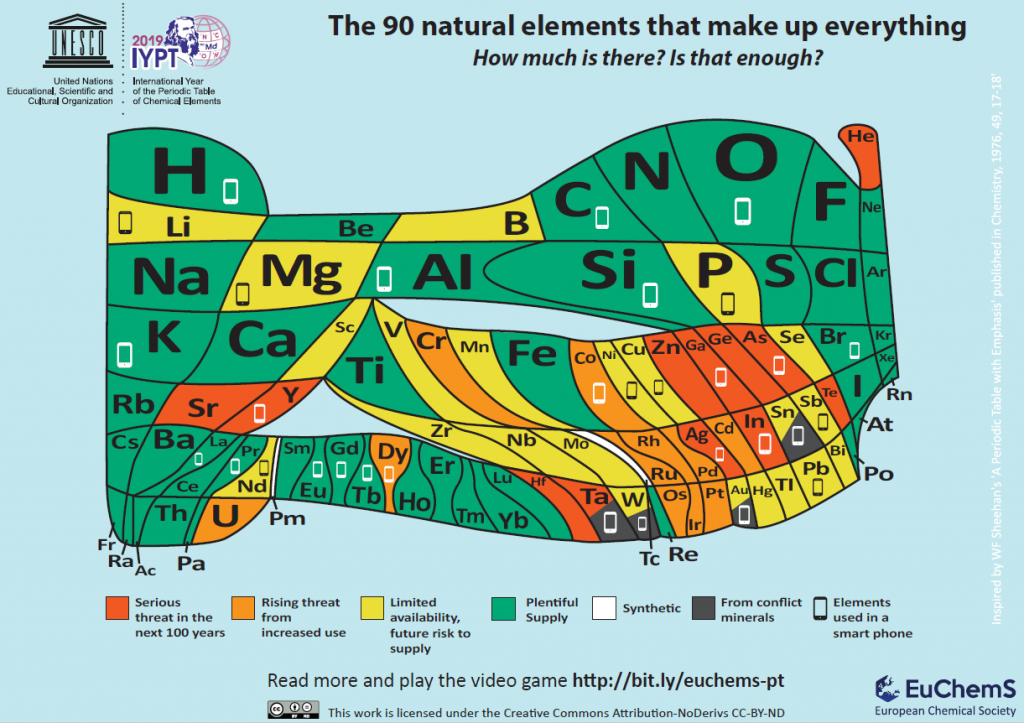 |
| Figure 2: Element Scarcity EuChemS Periodic Table [13] |
Unsurprisingly, the quest for these precious resources is already generating geopolitical tensions - not only are those elements essential to “green” and digital technologies, they are also key to the latest military technologies. At the moment, China controls over 90% of the production of rare earths and has the power to largely influence the market as well as to force technological transfers to its shore [12].
There is of course the question of recycling. Could we not recycle old electronics to mine for those minerals? This is the line that Japan is taking to regain some independence of supplies but progress is slow [12 pp.70], even if the country is on target to produce most if not all of the 2020 Tokyo Olympics medals out of recycled metals from old electronics [14]. The main obstacle to recycling is that hi-tech objects (and bear in mind nowadays that could be a kettle, or a pair of socks) contain increasingly mixed materials and complex alloys that can no longer be separated efficiently. Methods are difficult to find, often involve polluting processes, and the costs remain prohibitive. Printed circuit boards with ever smaller components are a a prime example; worse is the dispersive use of metals as pigments or additives, and in nanotechnologies [9 p.68]. “Circular economy” will never be achieved and even if we can do better, we are still very far from the mark as shown by the recycling rates in Figure 3. It is also worth noting that since the demand for these rare metals is growing, talking of circular economy doesn’t make much sense for the additional resources required to feed the growth still have to come from somewhere: “circular economy” and “ green growth” are not compatible.
 |
| Figure 3: The periodic table of global average post-consumer functional recycling - i.e. in which the physical and chemical properties that made the material desirable in the first place are retained for subsequent use [15]. |
In addition, our current manufacturing capabilities are such that switch to renewable energy supplies while keeping the current western levels of binge consumption is a physical impossibility [see e.g. 9 p.75]. The delays in which we are required to act are so short that we cannot rely on new energy technologies to be deployed in time to help with climate change [16].
Finally, it is also worth pointing out that the majority of renewable energy sources have an EROI on average no higher than 12:1. Estimates show that the minimum EROI necessary to offer the level of services expected in modern societies: a satisfaction of essential needs in terms of food, shelter, and sanitation; state provisions such as justice, defense, health, education; and entertainment has been estimated to lie between 12:1 and 13:1. With declining fossil fuel EROIs and renewables managing just that, we’re fast approaching a threshold when difficult choices will need to be made [see 17 p.54]. Even if there are dissensions on the meaning and use of those estimates [18], it should be clear that any energetic transition to a low-carbon economy will require large-scale compromise.
“Green” technologies aren't green; digital technologies aren't dematerialised
In addition to supply issues is a much darker aspect I have only hinted at up to now: pollution. Technologies branded as “green” are a far cry from being either “green” or “clean” (though they could be made “greener” and “cleaner”). However in Europe in particular, we no longer see a pollution that has been exported due to increasing concerns for our own environment. G. Pitron describes how stricter, yet highly justified environmental rules caused US company Molycorp to abandon its mining activities at Mountain Pass in California in 2002 or forced French chemical giant Rhône-Poulenc (now part of Solvay) to stop its rare earths refining activities at its La Rochelle factory in the mid-90s [12, ch.3]. Both firms ended up buying their rare metals from China, who was able to offer a cheaper supply than its competitors thanks to few environmental restrictions and cheap labour costs.
Europe and the US knew the real cost of extracting rare earths in a cleaner way that would not endanger future generations. However we chose to close our eyes to what was going on in China, says a French expert. [translated from 12 p.92]
Extracting rate metals involves breaking huge quantities of rocks, which then go through complex processes involving toxic chemical reactants such as sulfuric or nitric acid. The procedure uses up a lot of water; tailing ponds filled with toxic material leak; waste waters are released into the environment charged with acids, heavy metal and radioactive elements such as thorium (Th) with limited treatment. The region of Baotou in Inner Mongolia, now known as “the rare earth capital of the world” has greatly suffered and more than one visiting western journalist describes it as “hell” [12 chapter 2, 19, 20]. The image below shows “Baotou's toxic lake”, what used to be farmlands.
Tim Maughan writes
 |
| In Baotou, Inner Mongolia, the worlds largest rare earth mineral refinery pumps toxic and radioactive tailings into an adjacent artifical lake. © Liam Young/Unknown Fields [21] |
We reached the shore, and looked across the lake. I’d seen some photos before I left for Inner Mongolia, but nothing prepared me for the sight. It’s a truly alien environment, dystopian and horrifying. The thought that it is man-made depressed and terrified me, as did the realisation that this was the byproduct not just of the consumer electronics in my pocket, but also green technologies like wind turbines and electric cars that we get so smugly excited about in the West. [20]China’s is not the only environment (soil, water, plants, animals, people) suffering from high-tech’s reliance on rare metals, as headlines regularly remind us. Congo in particular is suffering from the unregulated artisanal mining of cobalt (Co), tungsten (W) and tantalum (Ta), which often fuels armed conflict and child labour as well as causes environmental damage [see e.g. 12 ch. 2; 22-24]. Furthermore, rare metals are not the only raw material required for “green techs”. Lithium (Li) is another element for which demand is increasing exponentially with the growth of the electric car market and whose sourcing creates huge environmental problems, e.g. toxic leaks in Tibet, water shortages in South America and more [23].
Now if we focus on digital technologies, it is crucial to realise that they are a far cry from being dematerialised, in a cloud somewhere. All the environmental impacts from sourcing raw materials detailed above apply to the hardware (e.g. see Figure 2 for a list of elements included in smartphones, including which are labelled as “conflict minerals”). In addition there is the increasing amount of energy required to store data; to transport the increasing volume of information we send daily through the network; to perform calculations, in particular those required for cryptocurrencies [see e.g. 25 - 28].
The Guardian’s Climate Home News writes that
The communications industry could use 20% of all the world’s electricity by 2025, hampering attempts to meet climate change targets and straining grids as demand by power-hungry server farms storing digital data from billions of smartphones, tablets and inter-connected devices grows exponentially. [25]
Indeed, Figure 4 gives recent predictions from carbon transition think tank The Shift Network. Their model implies that the energy consumption from communications technology increases annually by 8.5% [29].
 |
Figure 4: Percentage of the world's electricity used by communication technologies.
The 'Best Case', 'Expected' and 'Worse Case' are scenarios from Andrae & Edler (2015) [30] and correspond to increase in electricity efficiency and decrease in data traffic; efficiency and traffic data similar to the period 2010-2013; decrease in electricity efficiency and increase in data traffic, respectively. The 'Expected revised' and 'Revised higher growth and Energy Efficiency' are revised calculations by the Shift Network corresponding to the 'Expected' case with updated traffic data; and with increasing traffic data (at an updated rate) as well as increase in electricity efficiency from 2015.
|
Conclusions and further remarks
The arguments and figures above support the viewpoint that hi-techs and “green growth” are not a miracle answer to the challenge posed by anthropogenic climate change. At some point, we need to understand that exponential growth of material consumption and energy use on a planet with finite resources is simply not an option, and as the global warming clock ticks, not even in the short term. So we must ask ourselves, now: how much energy to we really need? What kind of transportation do we want for the future? How much data and videos do we genuinely need access to? How do we want to communicate so that it doesn't cost the Earth? This is not for experts to decide; these are be topics for urgent citizen debate.
Now let’s assume for a moment that climate change isn’t happening and that resources are infinite. Is business as usual OK? I would still argue that the same questions need to be asked and dramatic changes made, for the following reasons. In order to evaluate the environmental impact of a technology and its ethical status, its full life-cycle must be considered. It is clear to me that the large-scale pollution, environmental destruction, and global injustice wrought by the manufacture (and disposal) of modern “green” and digital technologies is enough to warrant a genuine debate on where our society wants to go with them. In addition, relying on increasingly complex networks and large-scale “green” energy production plants will ensure that energy supplies remain controlled by corporations and states, thus negating the opportunity for relocalisation of the energy supply and increased democracy (see this previous post and reference to Langdon Winner’s work). Finally, increased network complexity will increase vulnerability to systemic failures, when small perturbations can have dramatic consequences. An example is the huge blackout caused by a solar storm, which left the entire province of Quebec without electricity for 12 hours in March 1989 [31]. The systemic aspects requires much deeper investigation beyond our scope here.
It all sounds doom and gloom, but that is certainly not the aim of this blog. The message is that unless we look at reality as it is, rather than at a more convenient, virtual, smoothed out version of it; unless we realise that the world is as it is because of human choices and that we can make the choice to change everything, then we will not be able to work towards a better future. At the moment, we are still rushing ahead, researchers coerced to follow the funding lines, the public being told that high-techs, AIs and driverless electric cars are the future. We’re driving the innovation car at increasing speed, except that at then end of the road, there’s a cliff, and technological wings won’t be ready in time.
It is time to wake up, pause and think more deeply than the surface. What kind of world to we want to build? What technologies are required for this? I do not have answers to those questions, which require addressing in a genuinely democratic debate. I can only offer suggestions of what I think is worth investigating further and one interesting option is to follow Philippe Bihouix's idea to go ‘low-tech’ [9]. This will be explored in the next post.
________________________________
[1] Jonathan Watts. "We have 12 years to limit climate change catastrophe, warns UN", The Guardian, 8th October 2018. Available: https://www.theguardian.com/
[2] Jon Queally. "What’s not in the latest IPCC report? The 'much, much, much more terrifying' new research on climate tipping points", Common Dream, 11th October 2018 [Online]. Available: https://www.commondreams.org/
[3] David Wallace-Wells. "UN say climate genocide is coming. It’s actually worse than that", Intelligencer, New York Media, 10th October 2018. Available:http://nymag.com/
[4] Bill MCGuire. "An alarmist's guide to climate change", Responsible Science, vol. 1, Winter 2019. Available: http://www.sgr.org.uk/resources/alarmist-s-guide-climate-change [accessed 8th March 2019].
[5] Green growth and sustainable development. OECD. www.oecde.org [Online]. Available: http://www.oecd.org/
[6] HM Government. The Green Growth Strategy, Leading the way to a low carbon future, October 2017. Crown copyright 2017. Availablehttps://assets.publishing.
[7] HM Government. Industrial Strategy, Building a Britain fit for the future, November 2017. Crown copyright 2017. Available: https://assets.publishing.
[8] BP Statistical Review of World Energy 2018, BP, June 2018. Available: https://www.bp.com/content/dam/bp/business-sites/en/global/corporate/pdfs/energy-economics/statistical-review/bp-stats-review-2018-full-report.pdf [accessed 8th March 2019]
[9] Philippe Bihouix, L’Age des Low Tech : Vers une civilisation techniquement soutenable, Editions du Seuil, Paris, 2014.
[10] C.A.S Hall et al. “EROI of different fuels and the implications for society”, Energy Policy, vol. 64, pp.141-152, 2014.
[11] Various sources have various definitions for ‘rare metals’. I found the following website helpful: http://web.mit.edu/12.000/www/
[12] Guillaume Pitron, La guerre des métaux rares: la face cachée de la transition énergétique et numérique, Les Liens qui Liberent, Paris, 2018.
[13] Element Scarcity - EuChemS Periodic Table, European Chemical Society, https://www.euchems.eu/ [Online]. Available: https://www.euchems.eu/euchems-periodic-table/ [accessed 8th March 2019]
[15] UNEP (2013) Metal Recycling: Opportunities, Limits, Infrastructure, A Report of the Working Group on the Global Metal Flows to the International Resource Panel. Reuter, M. A.; Hudson, C.; van Schaik, A.; Heiskanen, K.; Meskers, C.; Hagelüken, C.
[16] R. Gross et al.’ “How long does innovation and commercialisation in the energy sectors take? Historical case studies of the timescale from invention to widespread commercialisation in energy supply and end use technology”, Energy Policy, vol.123, pp.682-699, December 2018.
[17] Pablo Servigne and Raphael Stevens, Comment tout peut s’effondrer: Petit manuel de collapsologie a l’usage des generations presentes, Editions du Seuil, Paris, 2015.
[18] M. Raugei. “Net energy analysis must no compare apples and oranges”, Nature Energy, vol. 4, pp.86-88, February 2019.
[19] C. Boutron, “Rare-earth mining in China comes at a heavy cost for local villages”, The Guardian, 7th August 2018. Available: https://www.theguardian.com/
[20] T. Maughan, “The dystopian lake filled by the world’s tech lust”, BBC Future, 2nd April 2015. www.bbc.com/future [Online]. Available:http://www.bbc.com/future/
[21] Behind The Scenes of Technology: Inner Mongolia Rare Earth Mineral Mines, images by Liam Young/ Unknown Fields, 2014. www.unknownfieldsdivision.com [Online]. Available: http://www.unknownfieldsdivision.com/summer2014china-aworldadriftpart02.html#6 [accessed 11the March 2019]
[22] J. Conca, “Blood batteries - Cobalt and the Congo”, Forbes, 26th September 2018. www.forbes.com [Online]. Available: https://www.forbes.com/sites/
[23] Amit Katwala. “The spiralling environmental cost of our lithium battery addiction”, Wired, 5th August 2018. wired.co.uk [Online]. Available:https://www.wired.co.uk/
[24] Nick Heath, “How conflict minerals funded a war that killed millions, and why tech giants are finally cleaning up their act”, 2015 (?), TechRepublic.www.techrepublic.com [Online]. Available: https://www.techrepublic.com/
[25] “‘Tsunami of data’ could consume one fifth of global electricity by 2025”, by Climate Home News, part of the Guardian Environment Network, The Guardian, 11th December 2017. Available: https://www.theguardian.com/
[26] John Harris, “Our phones and gadgets are endangering the planet”, The Guardian, 17th July 2018. Available: https://www.theguardian.com/
[27] Tom Bawden, “Global warming: Data centres to consume three times as much energy in next decade, experts warn”, The Independent, 23rd January 2016. Available: https://www.independent.co.uk/
[28] Samantha Page, “Mining Bitcoin is as energy intensive as mining gold”, Cosmos, 6th November 2018. www.cosmosmagazine.com [Online]. Available:https://cosmosmagazine.com/
[29] H. Ferreboeuf & al. Lean ICT - Pour une sobriété numérique - rapport intermédiaire. The Shift Project, March 2018. Available: https://theshiftproject.org/wp-content/uploads/2018/05/2018-05-17_Rapport-intermédiaire_Lean-ICT-Pour-une-sobriété-numérique.pdf [accessed 11th March 2019]
[30] Andrae, A., & Edler, T. (2015). On Global Electricity Usage of Communication Technology: Trends to 2030.
Challenges, 117 - 157. Available: https://www.mdpi.com/2078-1547/6/1/117 [accessed 11th March 2019]
[31] Sten Odenwald, “The day the sun brought darkness”, Nasa, 13th March 2009. www.nasa.gov [Online]. Available: https://www.nasa.gov/topics/